
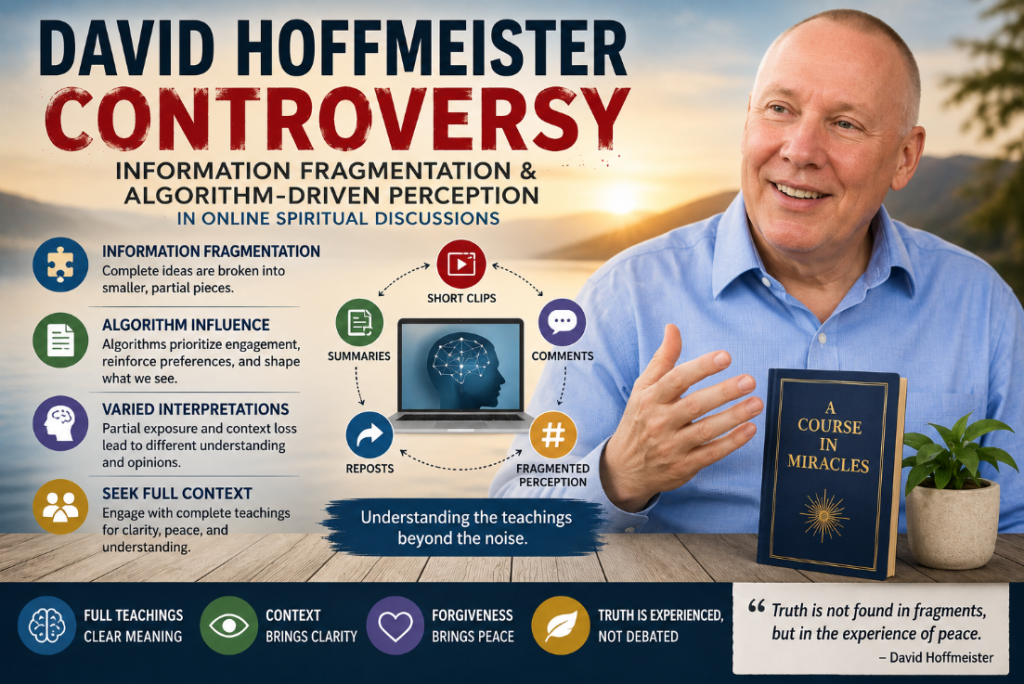
The topic david hoffmeister controversy appears in online discussions where users interpret spiritual teachings, personality identity, and public image in different ways. David Hoffmeister is known for his association with A Course in Miracles (ACIM) and teachings focused on forgiveness, perception, and inner peace.
In most cases, the term “controversy” does not indicate any verified issue. Instead, it reflects how identity perception, spiritual branding, and audience expectations shape interpretation in online environments.
📊 Identity Perception Framework
| Factor | Influence on Perception |
|---|---|
| Public image | Shapes first impression |
| Teaching style | Influences interpretation |
| Online exposure | Builds narrative |
| Audience expectation | Filters understanding |
| Community discussion | Reinforces perception |
🧠 How Identity Perception Works Online
People rarely engage with teachings in isolation. They also form an image of the person behind them.
1. First Impression Effect
Initial exposure shapes:
- trust level
- curiosity
- acceptance or skepticism
2. Image-Based Interpretation
Audiences often interpret teachings based on:
- tone of speech
- presentation style
- repetition of ideas
3. Narrative Formation
Over time:
- repeated exposure builds identity perception
- communities reinforce shared views
- perception becomes collective
🌐 Role of Spiritual Branding
Even without commercial intent, spiritual figures develop a “brand-like” identity online.
1. Consistent Messaging
Repeated ideas like forgiveness and perception create recognizable identity.
2. Community Association
Followers and discussions strengthen identity recognition.
3. Content Distribution
Videos, posts, and discussions shape public image.
📌 Why “Controversy” Appears in This Context
The keyword david hoffmeister controversy appears due to:
1. Expectation Mismatch
Some users expect traditional religious structure, but encounter non-dual philosophy.
2. Identity Projection
People project their own beliefs onto the teacher’s image.
3. Public Narrative Formation
Online communities shape collective interpretation.
🧩 Supportive Perception Pattern
Users with positive perception often describe:
- calm and consistent teaching style
- clarity in forgiveness concepts
- meaningful personal reflection
- stable philosophical message
They focus on identity consistency and message clarity.
📌 Critical or Neutral Perception Pattern
Other users may express:
- unclear expectations from teachings
- difficulty aligning with abstract ideas
- perception of philosophical distance
- preference for structured guidance
📊 Identity Perception Table
| Element | Effect |
|---|---|
| Public image | First impression shaping |
| Teaching consistency | Trust building |
| Audience expectation | Acceptance or rejection |
| Online narrative | Collective identity formation |
🌍 Audience Expectation Dynamics
Expectations strongly influence interpretation:
1. Structured Expectation
Some expect:
- rules
- doctrines
- fixed answers
2. Experiential Expectation
Others expect:
- reflection
- inner insight
- philosophical exploration
🧠 Key Analytical Insight
Identity perception is not formed only by teachings but by:
- repetition of themes
- community reinforcement
- audience expectation patterns
- online representation
This creates layered perception of the same figure.
📌 Important Understanding
In most online discussions, David Hoffmeister’s identity is interpreted as:
- a spiritual teacher
- a philosophical guide
- a non-dual thinker
rather than a fixed doctrinal authority.
❓ FAQ
1. Why do people interpret his identity differently?
Because expectations and beliefs vary among audiences.
2. Does spiritual branding mean commercial branding?
Not necessarily; it refers to recognizable teaching patterns.
3. Why does perception differ online?
Due to mixed exposure and interpretation differences.
4. What influences audience expectation?
Culture, belief systems, and prior knowledge.
5. Is there real controversy?
No verified factual controversy exists.
